

Orlando roofs face a cleaning problem most of the country doesn’t. Between 51 inches of annual rainfall, humidity that sits above 70% most of the year, and a tree canopy that shades entire neighborhoods, biological growth on roofs here isn’t an “if,” it’s a “when.” And because Central Florida homes come in at least five different roof styles, no single cleaning recipe works for every house on the block.
We’ve been cleaning roofs across Orlando, Winter Park, Baldwin Park, Lake Nona, Dr. Phillips, and the surrounding metro for years, and the one lesson that shows up on every job is that the method has to match the material. What works on a 10-year-old shingle roof in Kissimmee will damage a barrel tile roof in Winter Park and create a genuine safety problem on a standing-seam metal roof in Oviedo. This guide walks through how we clean each type, why we make the calls we do, and when we’ll tell you we can’t take a job. If you’re noticing the early warning signs your roof needs professional cleaning, this is the context behind what we’d do next.
Why Orlando Roofs Need a Different Cleaning Playbook Than the Rest of the Country
Those black streaks running down your roof aren’t dirt. They’re a living colony of Gloeocapsa magma, a cyanobacterium (not a true algae) that feeds on the limestone filler used in asphalt shingles. As the colony grows, it produces a dark UV-protective sheath, which is what gives the streaks their characteristic black-to-green appearance.
Gloeocapsa magma thrives anywhere it gets the three things it needs: moisture, warmth, and a food source. Orlando delivers all three in abundance. North-facing and west-facing roof slopes stay damp the longest because direct sun doesn’t dry them quickly. In tree-heavy neighborhoods like Winter Park, Baldwin Park, College Park, and Dr. Phillips, the canopy shades the roof deck for hours each day, extending that drying window.
The practical result is that Orlando sits squarely inside the “algae danger zone” that covers roughly 80% of the United States, with the Southeast at the highest risk. A roof that might stay visibly clean for five years in Phoenix will show streaking within 12 to 18 months here. That climate reality is why the rest of this guide focuses so heavily on method selection. It’s also why timing matters, and if you’re planning ahead, here’s our take on the best time of year to clean your roof in Orlando.
The Soft Wash Method: Why Pressure Washing Never Touches an Orlando Roof
Pressure washing a roof is the fastest way to turn a cleaning job into a replacement job. The Asphalt Roofing Manufacturers Association (ARMA) explicitly prohibits pressure washing asphalt shingles and prescribes a 50:50 mix of laundry-strength chlorine bleach and water, applied with a sprayer, allowed to dwell for 15 to 20 minutes, then rinsed with low-pressure water. GAF and CertainTeed, the two largest shingle manufacturers in North America, align with ARMA’s position. Pressure washing voids most manufacturer warranties.
Our rig uses a diluted sodium hypochlorite solution (the active ingredient in household bleach) delivered through an air compressor that feeds a chemical pump. The pump has adjustable dials that let us raise or lower the cleaning agent concentration on the fly. That’s the mechanism we use to dial in one formulation for shingle, a stronger one for tile, and a gentler one for metal, all from the same trailer.
The dwell-and-walk-away approach is what separates real soft washing from a half-measure. A shingle or tile roof doesn’t need a water rinse after the application. Subsequent Florida rain handles the natural rinse, and skipping a pressurized rinse step protects the underlayment and roof deck from water intrusion. If you want the deeper background on our approach, this post covers why soft wash roof cleaning is the best choice for Orlando homes.
The Five Roof Types We Clean Most Often in Orlando
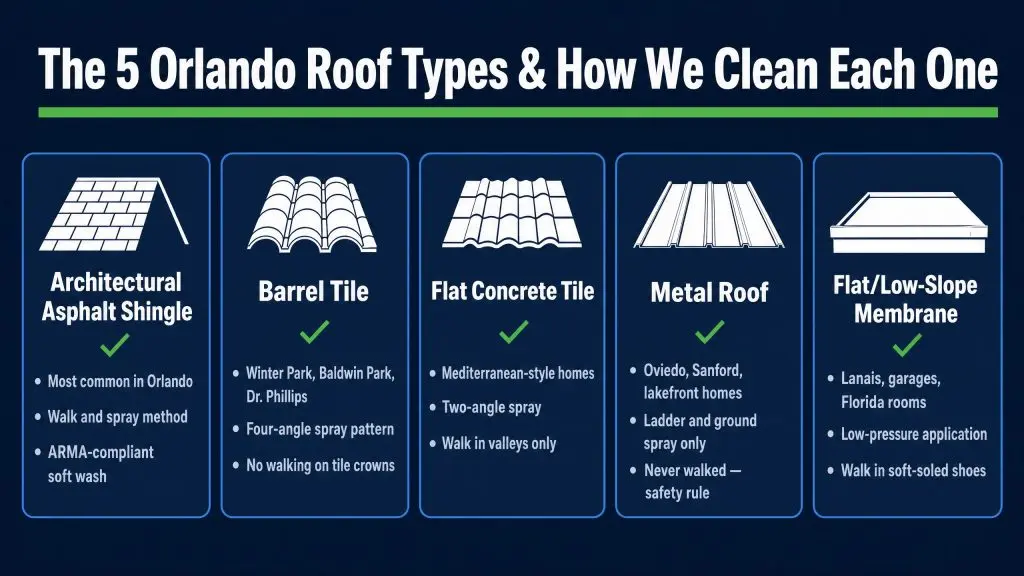
Here’s the short version of what we clean and how, before we go into detail on each one. This is the scope of our Orlando roof cleaning service across the metro.
| Roof Type | Common Orlando Areas | Our Approach | Typical Time | Rinse? |
|---|---|---|---|---|
| Architectural asphalt shingle | Lake Nona, Kissimmee, newer-build suburbs | Walk and spray (pitch permitting) | 1.5–2.5 hrs | No rinse |
| Barrel tile | Winter Park, Baldwin Park, Dr. Phillips | Four-angle spray, careful foot placement | 2.5–3.5 hrs | No rinse |
| Flat concrete tile | Mediterranean-style homes metro-wide | Two-angle spray, walkable | 2–3 hrs | No rinse |
| Metal | Oviedo, Sanford, lakefront properties | Ladder and ground spray only | 1.5–2.5 hrs | No rinse |
| Flat/low-slope (TPO, mod bitumen) | Lanais, garages, Florida rooms | Walk surface, low-pressure | 1–2 hrs | No rinse |
Architectural Asphalt Shingle Roofs
Why Shingle Is Still the Most Common Roof in Orlando
Architectural shingle is the dominant residential roofing material across the Orlando metro. Most post-1990 subdivisions, the majority of Lake Nona’s newer builds, and most of Kissimmee and Sanford run shingle. It’s affordable, carries 20 to 30-year manufacturer warranties, and installs quickly.
Shingle is also the roof material Gloeocapsa magma targets most aggressively, because asphalt shingles contain crushed limestone as a filler between the asphalt and the granules. The bacteria feed directly on the calcium carbonate in that filler, which is why shingle roofs show streaking earlier and more severely than tile or metal.
How We Clean a Shingle Roof
We start by bagging gutters to contain any cleaning solution runoff. We pre-wet all surrounding grass and plant beds so any overspray hits diluted, and we cover mature shrubs and delicate plants with plastic sheeting before any chemistry goes up on the roof.
If the pitch is walkable (generally under 45°), our tech goes up on the roof and applies the soft wash solution directly from the roof surface. Steeper pitches mean we spray from the perimeter with extension ladders instead. The solution dwells, the algae dies, and we walk away. A second coat goes on only if the staining doesn’t clear during dwell time.
We don’t rinse. Subsequent rainfall handles that naturally, and in Orlando, you’re rarely more than a few days from the next storm.
What to Expect on the Day of Cleaning
A typical shingle job runs 1.5 to 2.5 hours from setup to cleanup. There’s no high-pressure noise because there’s no pressure washer involved in the actual roof work. The most common question we get from shingle customers is whether we’re going to use pressure on the roof, and the answer is always no.
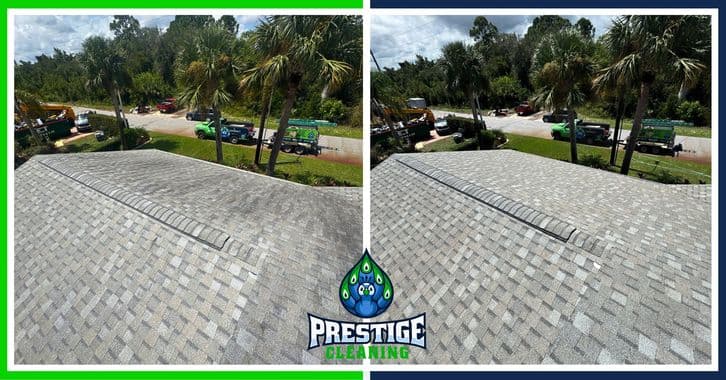
Visually, you’ll see black streaks start to lift within minutes. Full uniform color returns after one or two good rain events as the dead biological matter rinses away naturally. The full treatment is ARMA-compliant, which keeps your manufacturer warranty intact.
Barrel Tile Roofs (Spanish and Mediterranean Style)
Why Barrel Tile Defines Winter Park, Baldwin Park, and Dr. Phillips
Barrel tile is the signature roof of Mediterranean and Spanish-style homes in the older Winter Park housing stock, across Baldwin Park, in parts of Windermere, and throughout Dr. Phillips. Terra-cotta and earth-tone tile is part of the aesthetic identity of these neighborhoods, and HOAs in these communities actively monitor roof appearance. A streaked barrel tile roof can draw a compliance letter faster than almost any other visible issue on a home.
Barrel tile is also significantly more complex to clean than shingle, which is where most cleaning companies that treat “tile” as a single category run into trouble.
Why Barrel Tile Takes the Longest to Clean
A barrel tile isn’t flat. It’s a curved half-pipe, which means every tile has an outer crown and inner sides that aren’t visible from directly above. If we spray only from the down-slope direction, we hit the crown and miss the sides. The biological colony just continues growing on the surfaces we didn’t reach.
Our fix is a four-angle spray pattern. We apply the solution down-slope, up-slope, and from both cross directions so the chemistry reaches every surface of every curved tile. That’s why a barrel tile job runs 2.5 to 3.5 hours even on a mid-sized home, while a same-size shingle roof wraps up in under two.
Walking on Tile: Where We Step and Where We Don’t
Barrel tile is brittle. A hard step in the wrong place cracks it, and replacement tile is rarely an exact color match. We walk in the valleys and along the batten lines, never on the tile crowns. On steeper-pitched tile, we skip walking altogether and spray from the perimeter only.
Flat Concrete Tile Roofs
How Flat Tile Differs From Barrel Tile
Flat concrete tile has the look of a traditional tile roof without the curved barrel profile. Because there’s no inner curve, there are no hidden undersides, which means we can get full coverage with a two-angle spray instead of four. That saves roughly half the application time.
Flat concrete tile is still brittle, so the same foot placement rules apply. We walk in valleys, along battens, and never on tile crowns. A typical flat tile job runs 2 to 3 hours depending on roof size and pitch.
Metal Roofs
Where Metal Roofs Are Growing in Orlando
Metal is a smaller share of the Orlando residential market than shingle or tile, but it’s growing, especially in Oviedo, Sanford, newer custom builds, and lakefront properties. Both standing-seam and exposed-fastener metal profiles show biological staining, particularly on north-facing panels.
Coastal and lakefront homes need more attention to metal than inland homes do. Salt-adjacent air accelerates surface corrosion, and routine fresh-water rinsing extends panel life.
Why We Never Walk on a Metal Roof
Metal roofs are a non-negotiable no-walk surface for us. Metal gets dangerously slick when any liquid hits it, and a cleaning solution application guarantees liquid on the surface. Even a dry metal roof early in the morning is a fall hazard when dew is still present.
If you’re asking whether we can walk it carefully to get better coverage, the answer is still no. It’s a safety rule, not a preference, and it applies regardless of pitch.
Ladder and Ground Spray Method for Metal
Every metal roof we clean gets sprayed from ladders leaned against the edge of the house, supplemented by ground-based spray where reach allows. We use a gentler chemistry concentration on metal than on tile because metal doesn’t tolerate the stronger dilutions that tile handles fine.
Because metal surfaces are smooth and unobstructed, perimeter coverage is actually more efficient than on tile. A typical metal roof cleaning runs 1.5 to 2.5 hours.
Flat and Low-Slope Roofs on Lanais, Garages, and Florida Rooms
Most Central Florida homes have at least one section of flat or low-slope roofing, even if the main house is shingle or tile. Florida rooms, enclosed lanais, detached garages, carport additions, and some mid-century ranch builds use TPO, EPDM, or modified bitumen membranes.
These surfaces are walkable in soft-soled shoes, and we use low-pressure application throughout. The judgment call on a flat roof is staying clear of seams, ridge caps, and transition flashings where a concentrated chemical dwell could affect membrane adhesives. Most flat-roof sections take 1 to 2 hours to clean depending on square footage.
Roof Types We Don’t Clean (And Why We’ll Tell You That Upfront)
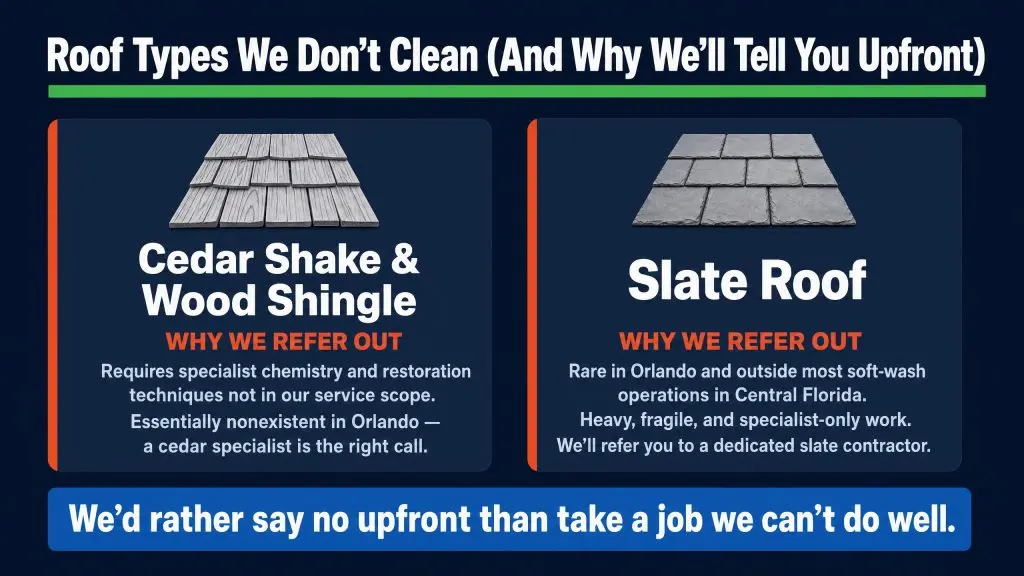
We don’t service every roof material that exists in the United States, and we’d rather say that directly than take a job we can’t do well.
Cedar shake and wood shingle roofs. These are essentially nonexistent in our Orlando service area, and they require specialist chemistry and restoration techniques that aren’t part of our service. If you have one, a cedar-specialist contractor is the correct call.
Slate. Slate roofs are rare in Orlando and generally fall outside the scope of most soft-wash operations in Central Florida. Slate is heavy, fragile, and specialist work. We’ll refer you to someone who does only slate if you need it.
Being upfront about what we don’t handle saves homeowners the trouble of scheduling an estimate for a job we’d ultimately decline.
Our Safety Decision Matrix: When We Walk, When We Spray From Below
Most competitors don’t publish how they decide whether to walk a roof or not. We do, because it’s the single biggest factor in both safety and quality.
| Condition | Our Approach |
|---|---|
| Shingle or concrete tile, pitch under 45° | Walk the roof, apply from surface |
| Any roof, pitch over 45° | Spray from ladder and perimeter only |
| Metal roof (any pitch) | Never walked. Ladder and ground spray only |
| Barrel tile, walkable pitch | Walk in valleys, four-angle spray technique |
| Flat concrete tile, walkable pitch | Walk in valleys, two-angle spray |
| Flat/low-slope (TPO, mod bitumen) | Walk surface in soft soles, low pressure |
The 45-degree threshold isn’t arbitrary. Above that angle, the risk of a slip outweighs the coverage benefit of being on the roof, and perimeter ladder coverage becomes the better tool.
How We Protect Your Landscaping on Every Cleaning
The most common concern we hear before a roof cleaning is whether the solution is going to kill the plants. The honest answer is that sodium hypochlorite in any concentration can stress vegetation, so the protocol matters more than the chemistry itself.
On every roof cleaning, we pre-wet all surrounding grass and plant beds before any solution goes up. Diluted runoff hitting already-saturated soil is much less likely to cause damage than concentrated runoff hitting dry ground. We cover mature shrubs and delicate ornamentals with plastic sheeting, and we bag gutter openings to contain the cleaning solution at the downspouts instead of letting it flow into beds.
The adjustable dials on our soft wash rig let us use the lowest effective concentration for each roof type, which reduces chemical load at the source. For gardens with herbs, edible plants, or fruiting trees, we either avoid that entire zone of the home or we include it in a written disclaimer before work begins so you can make the call. When you book a full-home cleaning, the same plant-protection protocol carries over from roof to house, and if you pair it with a house washing, all the same precautions apply.
When Won’t We Clean a Roof? Circumstances That Make Us Say No
We turn down jobs when we can’t stand behind the outcome. The most common scenario is a home with no gutters where the homeowner isn’t willing to accept some risk of vegetation burn around the foundation. Without gutters, the solution sheets off the roof edge directly onto whatever is below, and no amount of pre-wetting fully eliminates that risk. If the homeowner is comfortable with the trade-off, we proceed. If not, we decline respectfully.
We also decline jobs where pre-existing structural damage means the cleaning process itself could make things worse, and we refer out for roof materials we don’t service. Transparency on these judgments is how we avoid the “should have said no” regret after a job.
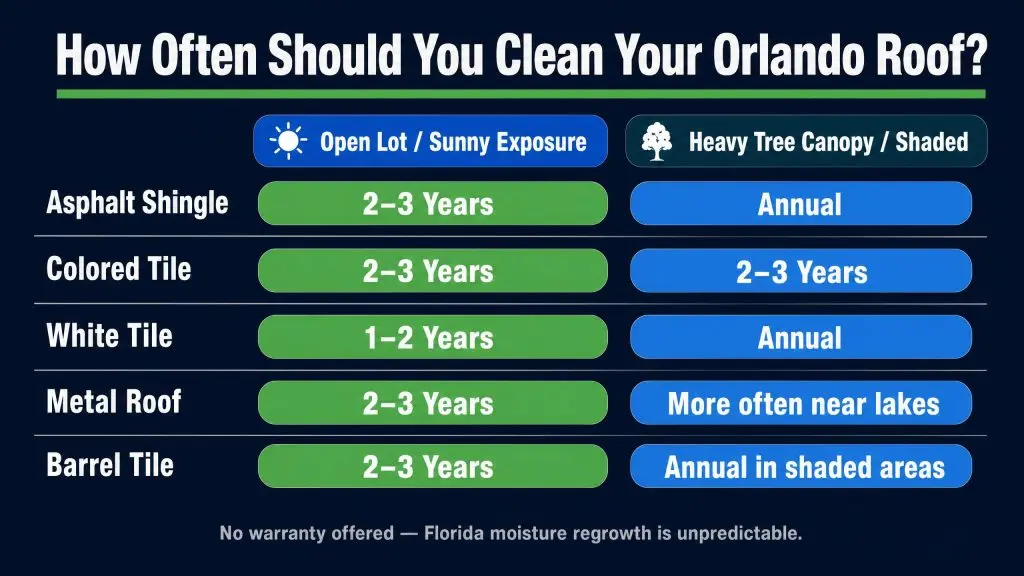
How Often Should You Clean Your Orlando Roof?
Frequency depends heavily on roof type and tree canopy. Here’s what we see in practice across our Orlando service area.
Shingle roofs in sunny, open lots often hold visibly clean for 2 to 3 years. Shingle roofs under heavy canopy in Winter Park, Baldwin Park, College Park, or Dr. Phillips frequently need annual cleaning because moisture simply doesn’t evaporate fast enough to slow colony regrowth. Colored tile tends to go 2 to 3 years between cleanings, while white tile shows staining sooner and often goes annual. Metal roofs typically run 2 to 3 years, more often for lakefront and coastal-adjacent homes.
This is also the reason we don’t offer a warranty on our roof cleaning work. Florida moisture accumulates too quickly for a “stays clean for X months” guarantee to be honest. We’d rather price the job fairly once than build the cost of a warranty nobody controls into every invoice. For a deeper breakdown of cadence by situation, this post on how often you should clean your roof in Orlando goes further.
Roof Cleaning Cost in Orlando by Type
Our roof cleaning pricing starts at $0.30 per square foot and reaches $0.40 per square foot for more complex jobs. We have a $200 service minimum on any job regardless of roof size, which keeps things fair for smaller homes and outbuildings.
| Roof Size | Low End ($0.30/sqft) | High End ($0.40/sqft) |
|---|---|---|
| 1,500 sqft | $450 | $600 |
| 2,000 sqft | $600 | $800 |
| 2,500 sqft | $750 | $1,000 |
| 3,000 sqft | $900 | $1,200 |
| 3,500 sqft | $1,050 | $1,400 |
The factors that push a job toward the higher end are predictable. Steep pitch means more perimeter setup time. Barrel tile means the four-angle spray technique, which doubles application coverage. Dense landscaping around the home means more pre-wetting and plastic coverage work. No-gutter homes require extra runoff containment. Most shingle roofs with standard pitch and moderate landscaping price closer to the low end. Barrel tile with steep pitch prices closer to the high end.
We offer a 10% military discount, and bundling multiple services (roof plus house wash, for example) reduces overall cost because we’re already set up on site. For more detail on pricing, this breakdown of roof cleaning cost in Orlando covers additional scenarios.
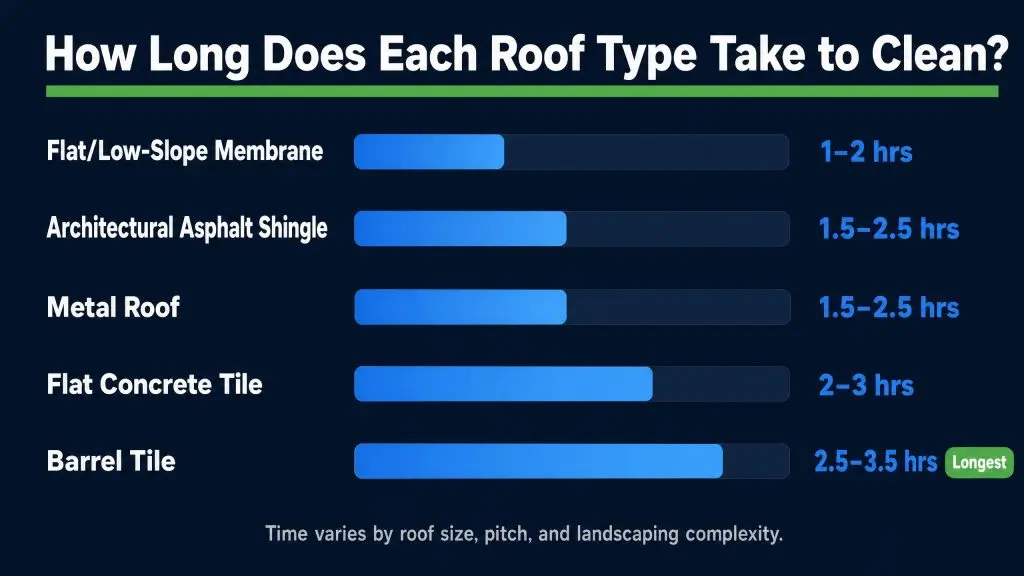
How Long Does Each Roof Type Take?
- Shingle: 1.5 to 2.5 hours
- Flat concrete tile: 2 to 3 hours
- Barrel tile: 2.5 to 3.5 hours (always the longest)
- Metal: 1.5 to 2.5 hours
- Flat or low-slope membrane: 1 to 2 hours
Time depends on roof size, pitch, and how much setup is required for landscape protection. A 3,500-square-foot barrel tile roof with mature landscaping and no gutters can take the full 3.5 hours. A 1,500-square-foot shingle roof with open beds and standard pitch can finish in 90 minutes. If you’re scheduling around a party or listing deadline, this guide on how long a typical roof cleaning takes has the full breakdown.
Frequently Asked Questions
Can tile roofs be cleaned without walking on them?
Yes. When the pitch exceeds 45° or the tile is visibly fragile, we spray from ladders positioned around the perimeter of the house. The trade-off is longer job time, because coverage angles are more limited from below than from on the roof, and on barrel tile the four-angle technique still has to be executed from multiple ladder positions.
Does soft washing kill the algae permanently?
Soft washing kills the existing colony on contact, but “permanent” isn’t the right word for Orlando. Gloeocapsa magma spores are airborne, roofs are exposed, and Florida’s climate is uniquely hospitable to regrowth. A thorough cleaning typically holds visibly clean for 1 to 3 years depending on tree canopy and slope orientation. Canopy-shaded, north-facing slopes regrow fastest.
What are those black streaks on my roof?
They’re colonies of Gloeocapsa magma, a cyanobacterium that feeds on the limestone filler in asphalt shingles. The dark color comes from a UV-protective sheath the bacteria produce. The streaking pattern follows water flow paths down the slope, which is why it runs vertically from ridge to eave.
What chemicals do professional roof cleaners use?
The industry standard is diluted sodium hypochlorite, the same active ingredient found in household bleach, applied at concentrations appropriate to the roof material. ARMA prescribes a 50:50 bleach-to-water mix for asphalt shingle. Tile tolerates stronger concentrations, and metal needs weaker ones.
Is roof cleaning worth it, or should I just replace the roof?
A roof covered in active biological growth is rarely at end-of-life. Algae staining is a cosmetic and functional problem, not a structural one. Cleaning usually costs a single-digit percentage of what replacement would cost, and slowing granule loss on a shingle roof can meaningfully extend its useful life. Replacement is the right call when you have structural damage, widespread granule loss, or leaks. Cleaning is the right call when the roof is sound but stained.
Does soft washing void my shingle warranty?
No. ARMA, GAF, and CertainTeed all prescribe or endorse soft washing as the approved cleaning method for asphalt shingle. Pressure washing is what voids warranties, because the high-PSI stream strips the granules that protect the asphalt layer underneath. The soft wash method we use is the warranty-safe approach.
Ready to Get Your Orlando Roof Cleaned Right?
Not every soft wash company understands the differences between roof types, and a generic approach on a barrel tile or metal roof causes problems that don’t show up until months later. We’ll come out with an in-person estimate, match the method to your actual roof material and pitch, and give you a straight answer on what your roof needs. We show up when we said we’d show up, which customers tell us is the part that actually stands out.
Call us at (407) 990-1877 or request an estimate and we’ll get you on the schedule.